EXPLORE THE BLOG
christopher Norment
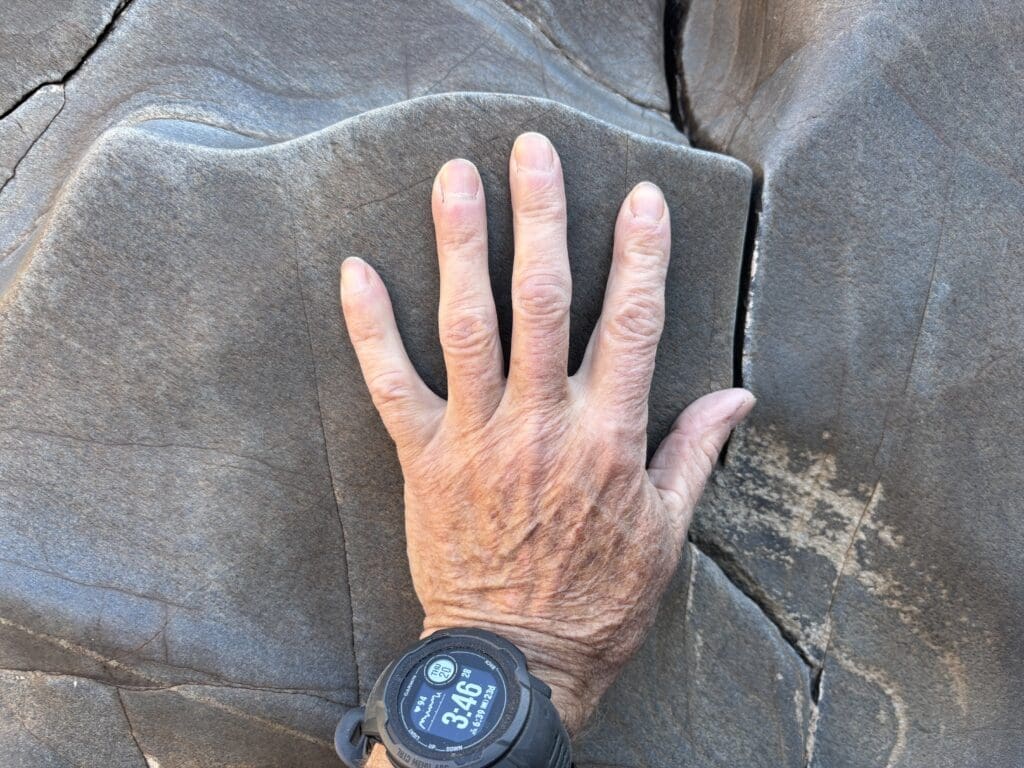
I place my left hand against the slab of grayish-black, water-polished rock. It is 3:46 PM Mountain Standard Time on March 20, 2025, and I’m somewhere deep in the Grand Canyon. The rock beneath my hand belongs to the Granite Gorge Metamorphic Suite, which sounds like the title of an orchestral piece by Ferde Grofé, rather than a series of geological strata roughly 1.75 billion years old, give or take a few million years. A look at the back of my hand reveals wrinkled and thinning skin, thick veins in bas-relief, plus some scars—vestiges of my age, which at the moment is 73 years and 194 days. The rock, which I take to be Vishnu Schist, is sensuous to my touch and smooth as silk—or better yet, smooth as the skin on the back of my hand was on September 7, 1951, the day I was born.
And thus the mysterious alchemy of time, that great temporal scaling that I can glimpse in only the faintest of ways, like the dimmest of stars flickering at the periphery of my vision, more sensed than truly seen: a particular date and time in 2025, my birth date in 1951, or the great skein of years spooling away from the rock beneath my hand, which extends across roughly 38 percent of the Earth’s history. “Our blood is time,” writes Anne Michaels—as is the Earth’s body.
The Vishnu Schist was formed from debris washed out of Proterozoic mountains, which then was metamorphosed by tremendous heat and pressure. The alluvium carried minute zircon crystals, and within those crystals, constant and relentless radiometric clocks that have kept on ticking away, across the eons. These clocks work by a sort of isotopic transubstantiation, as uranium-235 metamorphoses into lead-207 and uranium-238 metamorphoses into lead-206. These inexorable transformations are similar to the much more rapid beta decay function of carbon-14 occurring in my body, as the isotope is converted into nitrogen-14. There are timekeepers everywhere on this earth, in all animate and inanimate things.
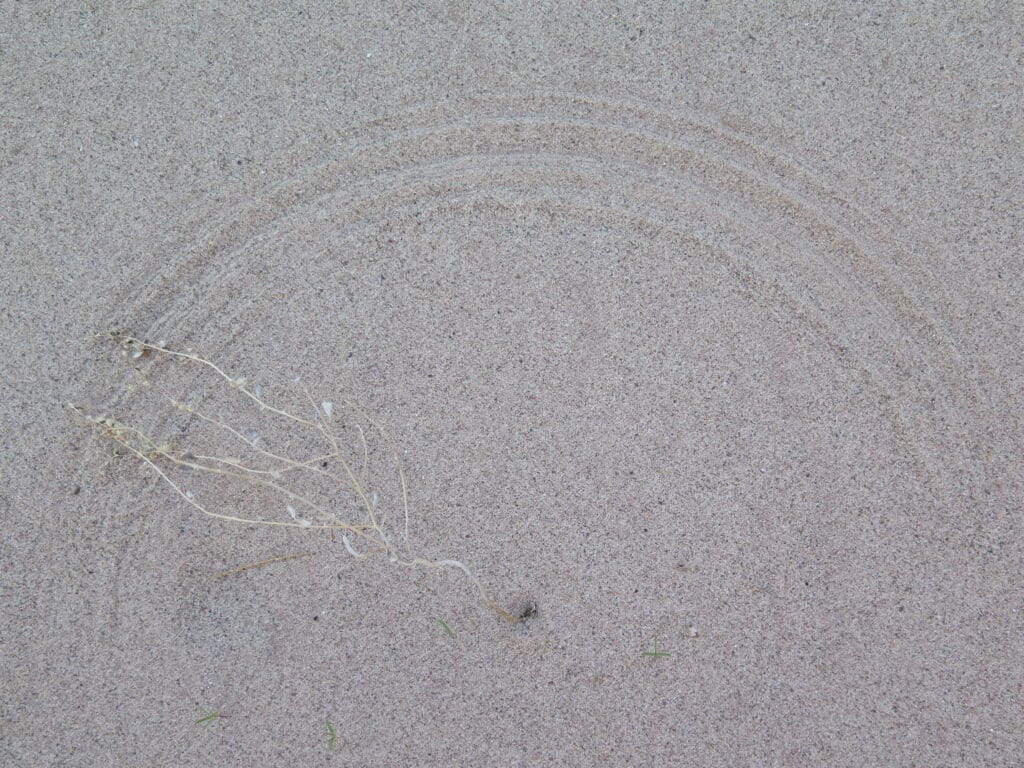
Behind me, a small creek winds through the schist. The water’s gentle murmur rises into the warm and still afternoon air, bathing the quiet, bathing the deep time of the rock and the shallow time of my life. My companions, Jamie and Gary, hike on. I lift my hand from the rock and follow them downstream, past the decaying carcass of a desert bighorn ram whose time recently ran its course. A few more twists and turns of the creek bring us to one of the Colorado River’s rapids, a thundering chaos of water, wave, and rock. Close at hand, brushstrokes of dried grass sweeping across sand, a flowering white primrose, and columns of fluted schist. Beyond the beach, the Canyon flares open and we can see the North Rim and Point Sublime, 5300 feet above us and six miles to the north. Between Point Sublime and the Colorado River is Mencius Temple, which guards the west side of Crystal Creek. Upriver and to the southeast, below Pima Point, are the golden-beige walls of Coconino Sandstone and blood-red cliffs of the Supai Formation.
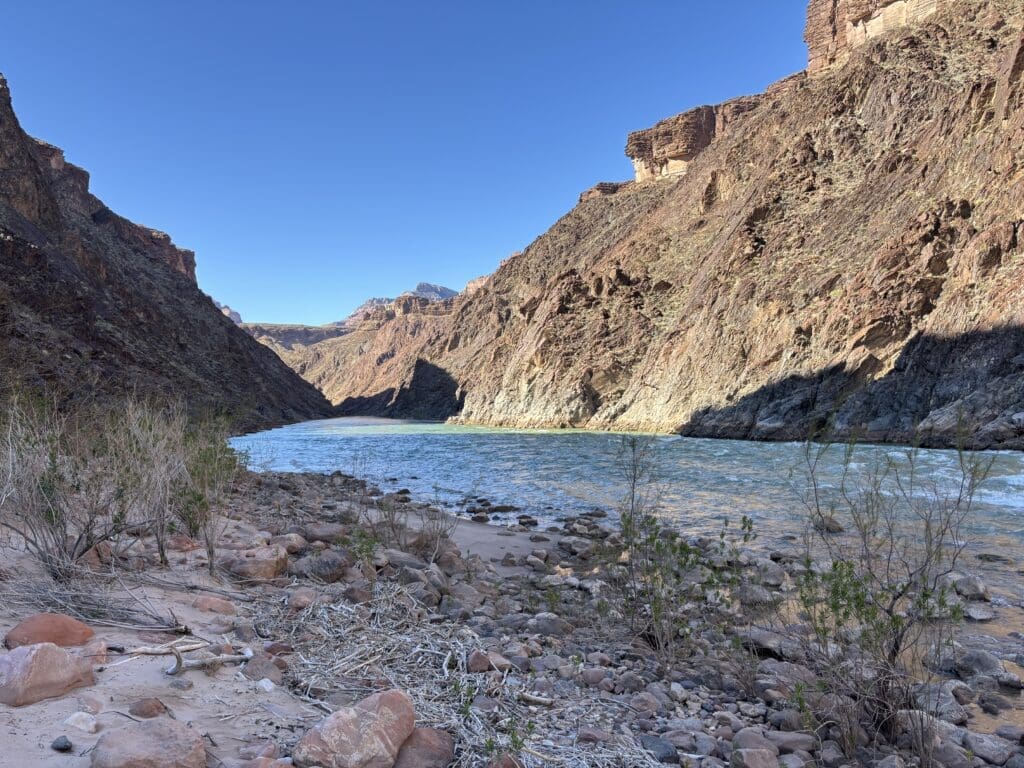
Here, in this lovely place, the precious hours of the late afternoon and evening await, as my clock and the Canyon’s clock tick on: timepieces built from flesh and blood, sun and wind—but especially from rock and water, an association captured by the Lepcha people of Sikkim, for whom the word gylań means not only the human spine, but also the course of a river and the flow of time[1]. This connection between time and flowing water also is marked by the title of the Sierra Club book, Time and the River Flowing, which is both an adventure narrative and a eulogy. Time and the River Flowing describes a 1963 river trip through the Grand Canyon and the drowning of Glen Canyon in the same year, when the Bureau of Reclamation closed Glen Canyon Dam’s flood gates. Eventually, a 180-mile-long section of the Colorado River stopped flowing, as its time temporarily died beneath the rising waters of Lake Powell.
∞
In the early morning, we begin our hike to the South Rim by retracing our steps through the Vishnu Schist. Soon after leaving the creek, we step across the Great Unconformity, an erosional surface that spans the 1.2 billion-year-gap separating the Canyon’s basement rocks from the 508-million-year-old Tapeats Sandstone. We slog (or rather I do; Jamie and Gary—the young’uns—quickly pull ahead) up the steep trail transecting the Bright Angel Shale, then pass through depositional beds of Muav Limestone. Before noon we top out above a great cliff of 340-million-year-old Redwall Limestone. Since leaving the river we’ve tracked the course of life’s history from a marine world dominated by simple single-celled organisms to one inhabited by highly complex creatures, including brachiopods, corals, crinoids, bivalves, trilobites, snails, nautiloids, and fish.
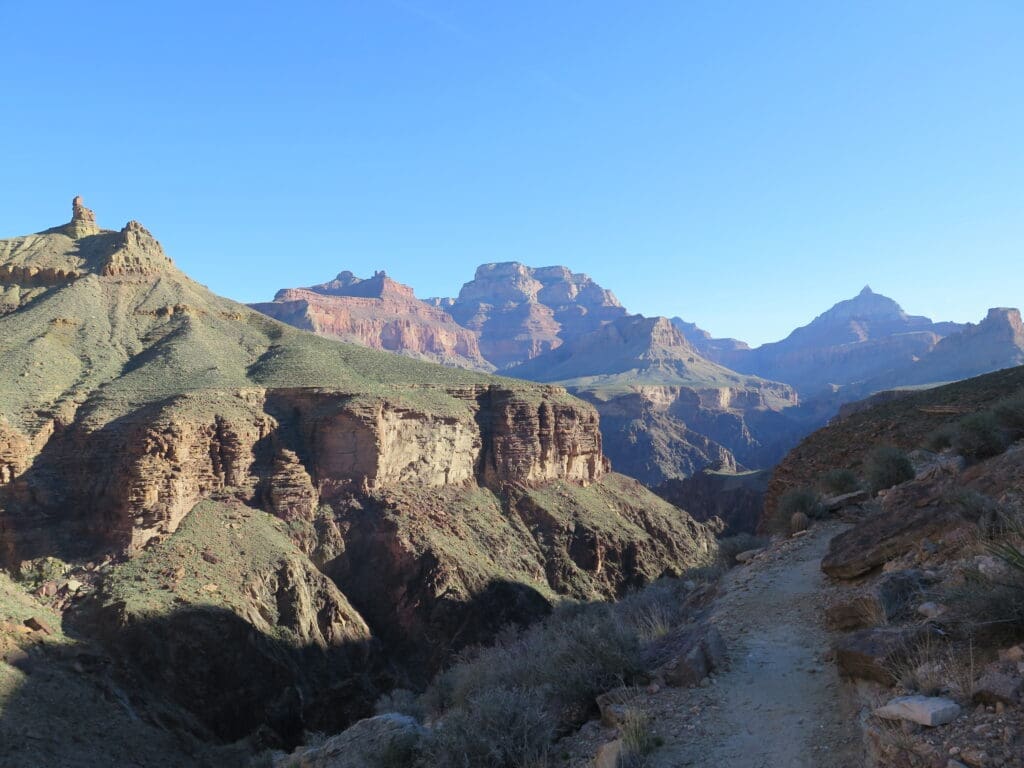
Above the Redwall Limestone we meet the erosional surface where the younger Supai Formation once lay. The trail levels out, and our world opens up in a way that summons all the vectors of space. Although we’re still 2200 hundred feet below the Canyon’s rim, there’s a sudden sense of distance as vast and limitless as the great stretch of geological and evolutionary time that we’ve just traversed, from the Vishnu Schist of the Paleozoic through the Redwall Limestone of the Carboniferous period. The North Rim, with its crowning cliffs of 270-million-year-old Kaibab Limestone, may be only eight or nine miles away, but it feels like two or three times that, and then there are the long views up and down river, along corridors of rock and time. It is difficult to take it all in, to process the spatials and the numinous light.
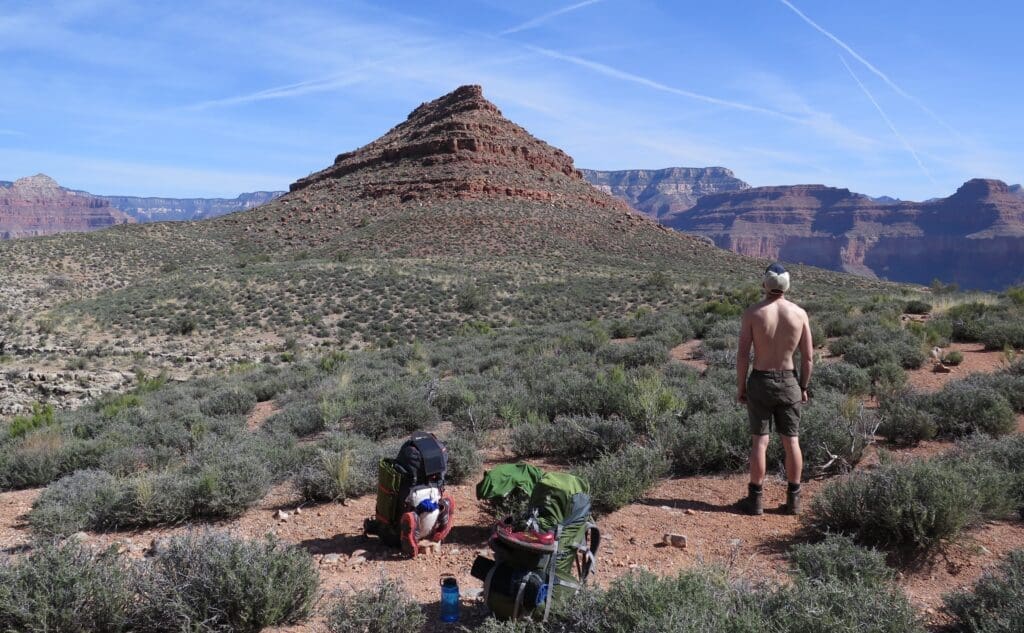
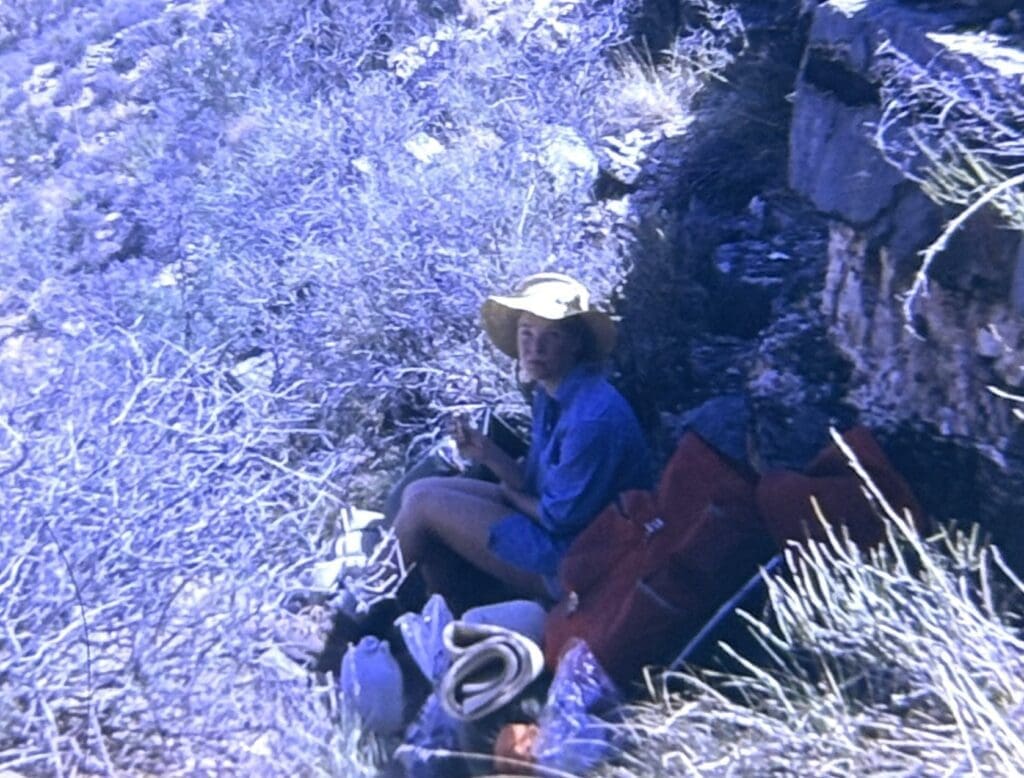
I’ve passed through here four times before. The first time was in 1971, when I was with my girlfriend from college. Hikes with my daughter (2005), brother-in-law (2006), and son (2016) followed: five trips across fifty-four years, or almost three-quarters of my elapsed life, and in this place and space it’s easy to time-travel. On that first hike I was only nineteen and understood little about the world or myself. C. and I were tracking the trail in the opposite direction, toward the river. It was April and much hotter than on this March day. A morning’s walk brought us to a sliver of shade beneath a small overhang, where the route to the creek fell away from us, down into the Redwall and back through geological time—but also into our future, where we would break apart seven months later.
Now, as I look past that same sheltering overhang and into the Grand Canyon’s depth and breadth, the years spall away from me, like rock falling from the Canyon’s cliffs. For a few minutes I am back there, fully, having leapt across what feels like a vast chasm of time separating my nineteen-year-old and seventy-three-year-old selves, which is only an instant in the context of the Grand Canyon’s geological history. A sweetness settles around me, as intoxicating as the riparian scent of seep-willow that graces the cool morning air along the Colorado River, but it’s a sweetness that has nothing to do with a personalized, restorative nostalgia—an imagined pseudo-past that never was, in a world that was better than it (or I) really was. Instead, there’s a tender regard for C. and my nineteen-year-old self: my strengths and weaknesses, loyalties and failures, my struggle to find a way through the world and past the bitter, tectonic events of my childhood. I was just a kid, and now—all these years later—I finally can forgive my youthful trespasses. And I hope that C. can say the same thing about herself, wherever she might be.
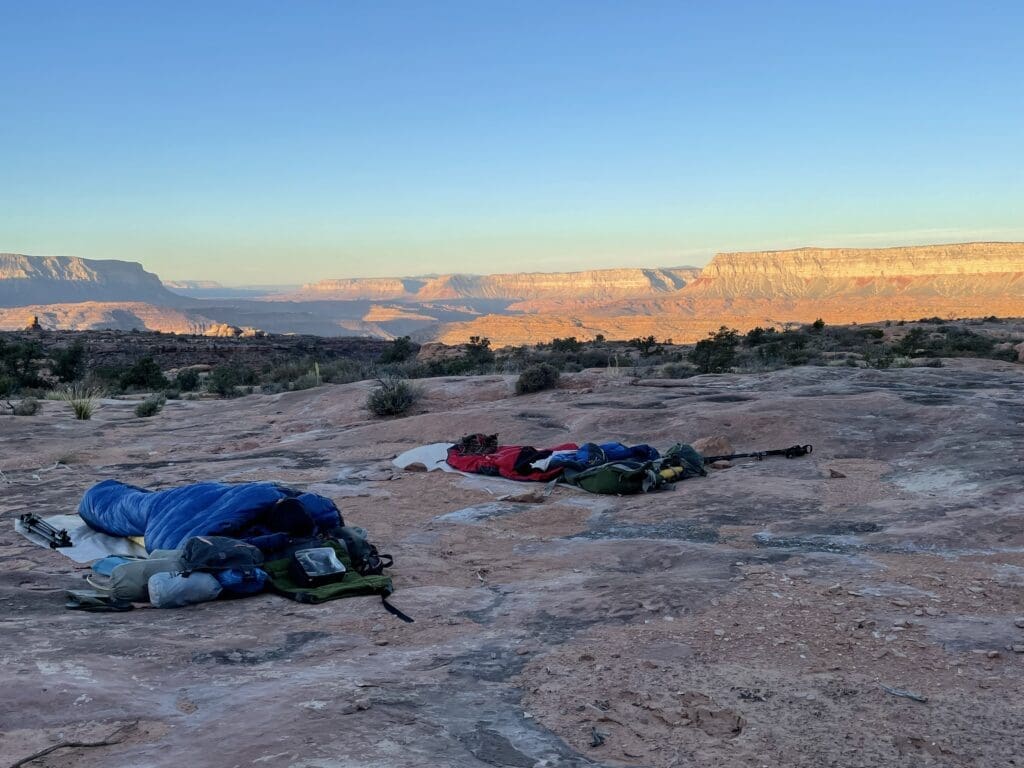
“O to realize space!”: that was Walt Whitman’s joyous song. But if Whitman had known something about modern theoretical physics, he might have written, “O to realize space-time!” That is my senescent song, as a vivid sense of the space-time continuum manifests itself in this powerful place and moment. I feel it in my mind and heart, but most intensely as a physical sensation nested in my solar plexus. For me this fusion (or confusion?) of space and time is an almost unique aspect of the Grand Canyon, a visceral response that I’ve experienced nowhere else in the world, at least so profoundly. This space-time sensation is not just a product of my repeated visits to this particular spot, because I have encountered it elsewhere in the Canyon—say upcanyon in Furnace Flats, where the strata of soft and easily eroded rock have created an opening expanse running from river to rim, or out on the great sandstone sweep of the Esplanade Platform, west of Tapeats Creek. This compelling space-time sensation is partly what has drawn me back to the Grand Canyon, again and again, on five river trips and over thirty backpacking trips.
The space-time concept that seems most appropriate here—although likely in a technically incorrect way—is that of the world-line: “a path in space-time, especially that traversed by an elementary particle from its creation to its destruction.” That “elementary particle” is me, with my world-line passing through this place in 1971, 2005, 2006, 2016, and 2025. These visits, in the company of people I love or once loved, add resonance to this spectacular place, and to time’s passage. But my tiny and inconsequential slice of this multidimensional space-time continuum is immersed in a much larger expanse of it, which in the Grand Canyon flows outward in all directions, across more than 1.75 billion years of time.
The years, the years.
The Japanese monk Daichi Sokei (1290 – 1366) taught that, “Among all living things, not one escapes death. Mujō [impermanence] is hanging over your head at every instant and may strike before you know. When your life receives a blow from mujō, you will go forward into death alone. There will be none to keep you company, not even those who love you the most. Power and wealth are useless; not even the royal crown will follow a dead body. That is why the sutra says, ‘This day is ending and with it must end your life.’ You must concentrate and consecrate wholly to each day, each moment, as if a fire were raging in your hair.”
My world-line runs on, from its creation toward dissolution, and at almost seventy-four it is impossible for me to deny mujō, eitherintellectually and viscerally. But for me this is not a morbid thing, even though I know that I will miss—deeply—the beauties of this world, both great and small, a sentiment captured in such a touching way by the Greek poet Praxilla of Sicyon some 2,500 years ago:
Loveliest of what I leave behind
is the sunlight
and loveliest after that the shining stars
and the moon’s face
but also cucumbers that are ripe
and pears and apples.[2]
Given my age, all that I still hope to accomplish in my life, and the fact that I have made my home in far-off Mississippi, I doubt that I will be fortunate enough to pass this lovely way one more time. And each year “it”—the climb from the Colorado River—gets a little harder. There will come a time when I am just not up to the task, even though at the moment I’m still happy to paraphrase the Zen monk Jakushitsu Genkō: “Old now, I feel it more than ever—so good to be here in the Canyon!”[3] Chances are I’ll never again walk across these beautiful rocks and through this particular sprawl of space, although I’d welcome a return if my body holds up for a while longer. But mujō reigns, both in the narrow world-line context of my senescing body and the much larger temporal and spatial setting of the Grand Canyon. And so, given mujō, space-time, and all that has been in my life, the only task that I am left with on this bright and shining day is to shoulder my pack, feed the fire in my hair, and embrace what remains of the journey.
Walk on.
[1] Robert Macfarlane introduced me to this concept in Is a River Alive?
[2] Translated by Joseph Stroud.
[3] The original quote (“Old now, I feel it more than ever—so good to be here in the mountains!”) is from Jack Turner’s book, Teewinot.


