EXPLORE THE BLOG
christopher Norment
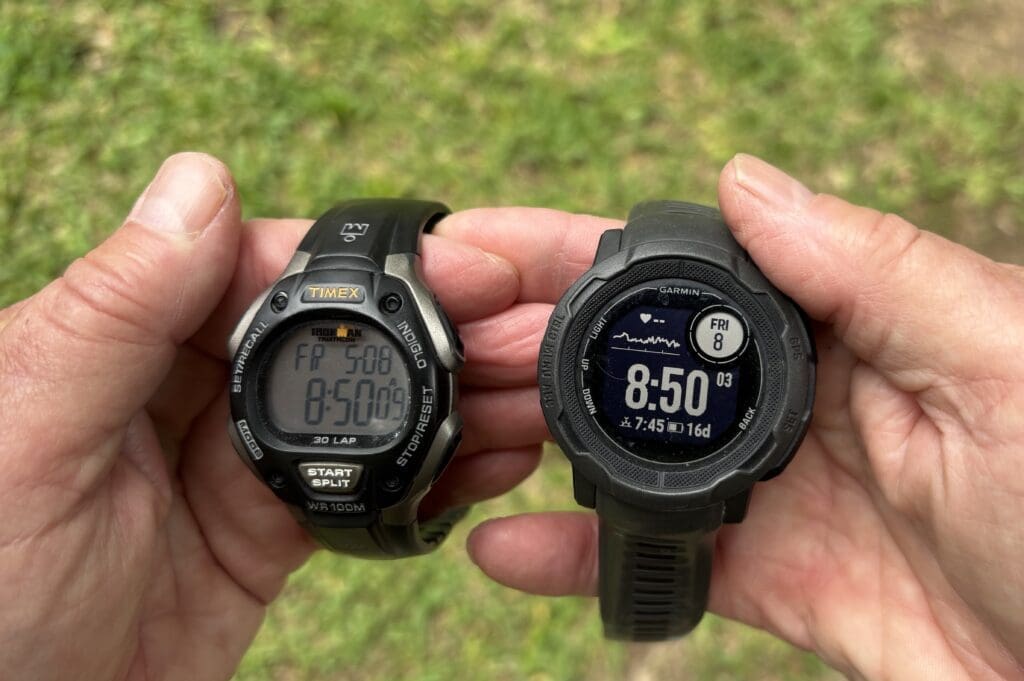
Thanks to some mysterious alchemy of genes, neurotransmitters, and environment, I’ve never been particularly susceptible to the lure of alcohol or drugs. Of course, I have my own temptations. I won’t mention the embarrassing ones, but I’ve sometimes been seduced by the complicated algorithms that spread their pernicious brain worms via social media platforms like Facebook and Instagram.
But never mind the Mӧbius strip of infinite scrolling. Never mind the likes, views, shares, comments, and targeted advertisements for treasures that I absolutely must have, to improve the sorry state of my quotidian life. It’s fortunate that I’ve become at least partially immune to these virulent digital infections, because there are no vaccines available.
But give me a “smart” GPS watch and I’m ready to push the plunger on that algorithmic syringe. O baby: sync me up with Bluetooth and tie me down. Let me obsess about exercise, sleep, and fitness. Let me track my “analytics” through the days, weeks, months, and years, as those lovely data sing their siren song. After all, I am a scientist—or at least I once was.
Let me monitor—constantly—my steps, floors, intensity minutes, sleep metrics, VO2 max, calories, heart rate, HRV (heart rate variability), recent stress, body battery, power, run cadence, and training effect.
Let me fret if I don’t meet my daily goal for steps. But if I’m close, let me pace around the house for five minutes before heading off to bed and that suddenly well-earned sleep.
Let me wake up in the morning feeling tired or refreshed but let me check my watch to see how my sleep really was. Did I earn a measly 49 (poor), or a 79 (fair)? (O for that extra 1 point, or for the 90 (excellent) score that I’ve never achieved!) Let me yearn for a “good” sleep, as judged by my watch, much like children desire gold stars on their grade school art projects.
Let me finish a good geezerly run, feeling quietly pleased about pushing myself—only to check my VO2 max score and find that it was lower, dammit, than scores on slower runs, even though I felt like my lungs and circulatory system delivered more oxygen to my muscles. And so, let me become exercised by my exercise metrics.
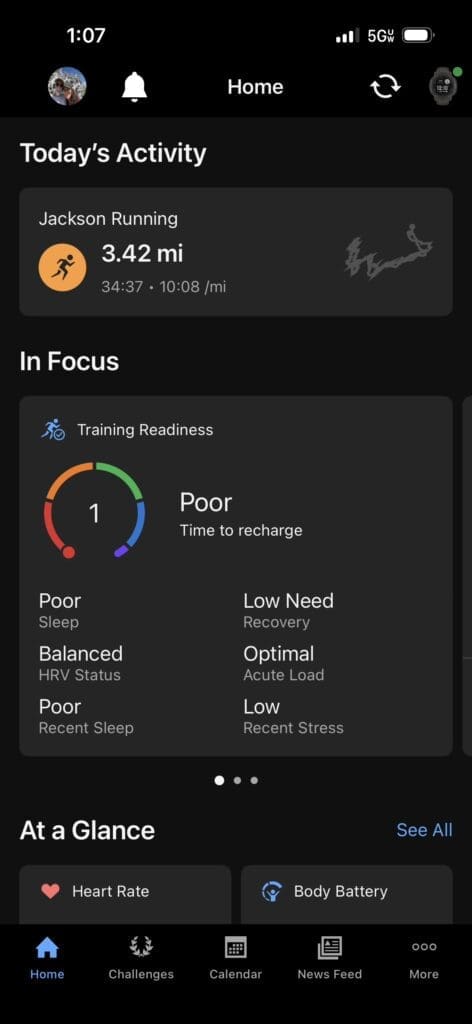
And let me be coached, admonished, and sometimes rewarded by the sympathetic app that interfaces with the machine on my wrist:
“Strive for better sleep tonight to get back on track.”
“Your body battery is down 22 points overall since you woke up. Relaxing even a short time can restore your body battery.”
But take heart, even if I’m sleep-deprived and tired, because “you have found a good balance between daytime stress and recovery over the last few days.”
“Listen to your body.” (It’s always talking to me, as I learned decades ago from Olivia Newton-John.)
In all of this, never mind that compulsively checking my watch generates anxiety because I’m chasing arbitrary goals (steps, flights of stairs, activity minutes) or reacting to scores produced by black box algorithms. These algorithms exert their tidal pull on me as though I’m some grunion-like creature, mindlessly swimming onto the beach to spawn (or exercise) beneath a full moon.
Take sleep scores. The manual for my watch tells me that they are based on a combination of duration (compared against age-based recommendations); architecture (how much time is spent in light, deep, and REM phases and how my body transitions between them), and stress/HRV (based on autonomic nervous system data; a low heart rate and high HRV indicate my body is actively recovering). As I sleep (or struggle to) my watch records heart rate, its variability, and “movement data,” which are plugged into an algorithm to produce a nightly sleep score.
Along the same lines, my watch calculates VO2 max during exercise “by tracking the relationship between wrist-based heart rate and pace,” which means that it is a proxy for actual VO2 max.
Never mind that metrics such as sleep scores and VO2 max are products of undefined computational instructions. Trust them. Never mind that VO2 max can only be accurately calculated in a laboratory, using a treadmill and mask connected to a machine that measures oxygen uptake and exhaled carbon dioxide and oxygen. And never mind that the GPS on my watch sometimes misfires, as when it informed me that during a longer run I’d set a “Personal Record!” by covering a mile in 7:39. I wish, but that’s a pace I last saw the ass-end of years ago.
Or never mind that my watch recently told me that I’d had a night without REM sleep, even though I’d enjoyed some excellent dreams (ironically including one about running a marathon), and most vivid and complex dreams occur during REM sleep. And never mind that my watch sometimes records incorrect times for when I fall asleep or wake, and so erroneously calculates my sleep duration and quality.
The point is that my “smart” watch exploits my analytical nature and interest in exercise and health. It amplifies my obsession with things that I shouldn’t obsess about and sometimes makes mistakes. I don’t need to count stairs, steps, or even hours of sleep. I know when I get enough sleep or exercise. I know when I have a good run. I am not an elite or even moderately competitive athlete and there’s no need to track metrics important to them. There are no FKTs (fastest known times) waiting for me, only a gathering host of SKTs (slowest known times), and I don’t need any reminders about those.
At seventy-four the dogs of senescence are nipping at my heels. There’s plenty of residual anxiety in that chase and I don’t need to add a collection of attention-thirsty algorithms to the pack. What my life does need, though, is less noise, and fewer of those algorithmic hooks that distract me from what’s left of my precious days on this earth. I’d like to live in a more attentive and relaxed way, despite the stress produced by the Orange Menace and his sycophants.
But if other folks want to embrace the avalanche of data that a GPS watch generates, more watts to them. If doing so brings pleasure and satisfaction, or helps monitor health-related issues, great. I know people who love their exercise analytics and posting data from their runs and bike rides on Strava. My son is one of them and I’m envious of his accomplishments. If I were as fit as he is, I’d probably do the same thing. I don’t want to behave like an arrogant crank who’s convinced that what’s right for him is right for the world. I’ll leave that role to RFK, Jr.
But as for me: I’m replacing my complicated GPS smart watch with a low-tech digital watch that uses a few simple algorithms to track time and date, and operate as a timer, stopwatch, and alarm—and is not hooked into the Internet. I figure that’s all I need to get through the day (and night).
∞
I vaguely recall when I first heard about the “Internet of things” (IoT) – that vast network of “physical objects that are embedded with sensors, processing ability, software, and other technologies that connect and exchange data with other devices and systems over the Internet or other communication networks.” The concept was disturbing back then—this was sometime around 2010—because it suggested that the Internet was about “things” rather than people (which seems mostly the case). And it is infinitely more frightening in 2026, now that we have the AIoT: the Artificial Intelligence of Things: “systems capable of sensing, learning, and acting on data without continuous human intervention.” As I understand it these systems include (or will soon include) everything from automobiles to toasters, smart speakers, ATMs, GPS units, thermostats, the electrical grid, communication devices, and that Bluetooth-enabled GPS watch that I’ve worn for the last three years.
I’m a prisoner of the AIoT, much as most everyone is. I suspect that the reality of this incarceration means that we humans are basically screwed. There’s little that I can do about my existential vulnerability to the AIoT, although I can make choices that decrease the assault of externally-generated noise and nurture my ability to pay attention to the world—for example, by not acting like a “thing ”as it responds to that small but powerful machine on my left wrist. I can increase my quietude and pleasure and behave less like a victim of operant conditioning, one more human rat in an algorithmic Skinner box.
So: let me lay aside the smart watch and dumb down my life a little, whether sleeping, running, or just moving through the day. Let me do these things—especially the running—in a more peaceful and focused way, as I once did. And what I’m remembering here is a lovely summer day a few years back, when I ran north along the Pacific Crest Trail from Hart’s Pass in Washington: on through one alpine flower garden after another, with the high peaks of the North Cascades shining to the west and a huge gulf of space falling away into Canyon Creek. Mile after relaxed mile, the simple watch on my wrist telling me nothing about pulse rate, pace, miles, splits, or VO2 max. For a while there were just the mountains and meadows, the alpine world going on and on, and my body and mind, quiet and alive to the day. And if I can wean myself from some of the relentless algorithms that infect my life, I might be that way again.