EXPLORE THE BLOG
christopher Norment
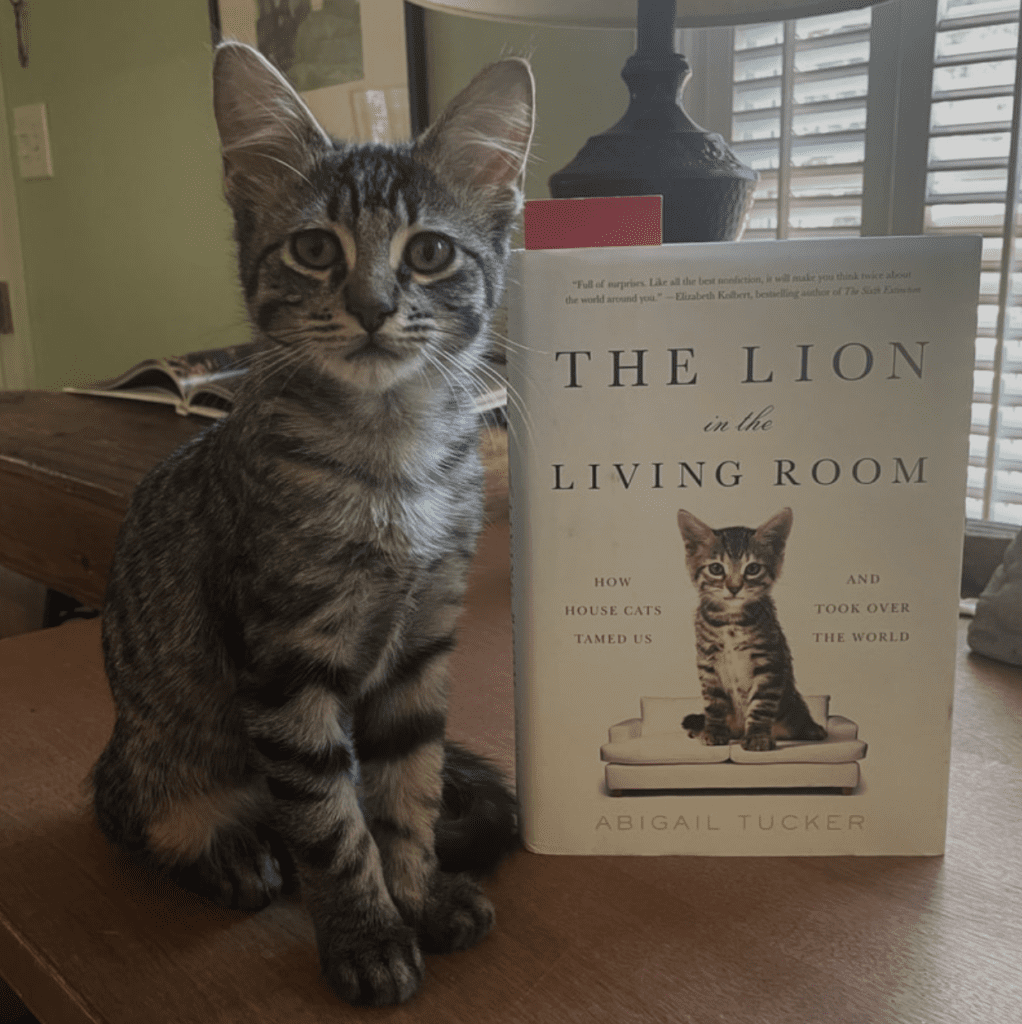
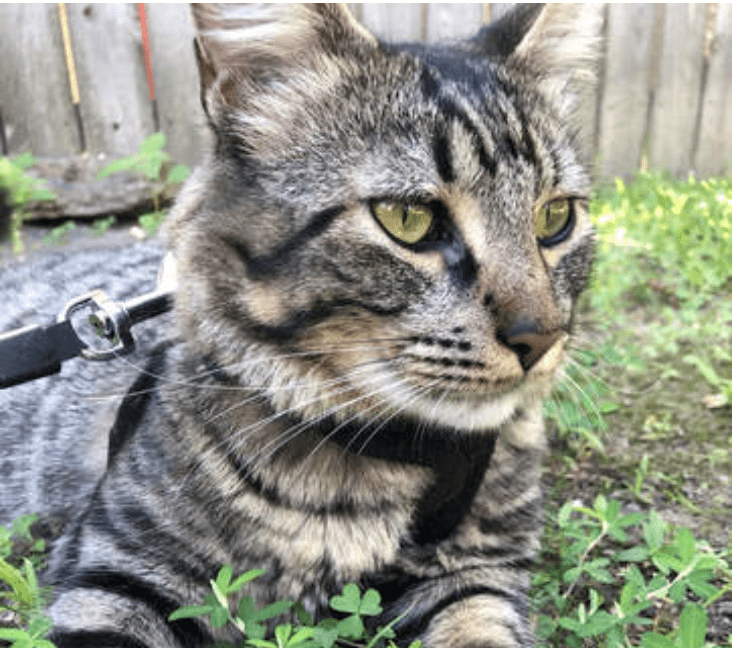
On days when Eli is working, it’s my job to walk Darwin the Cat, although she helps when she can. Unless it’s raining or brutally hot, he’s eager for the outside world, much as I am—although he must suffer the indignity of a harness and (sometimes) leash, lest he vanish into the wilds of our Jackson neighborhood or practice the hunting skills that are such an integral part of his feline essence. Darwin is an adept and natural-born killer, and minus a firm check on his inclinations our yard would be littered with songbird feathers and macerated lizards.
Walks with Darwin last at least 60 minutes, although by his standards that’s rarely adequate and we often are out for more than an hour. If I lift him up to take him inside before he’s had sufficient outside time, he protests by raking his hind claws across my forearms (hence one of his other names, “Doosh”). I tell him that there’s more to life than walking an ungrateful cat, but he remains unmoved. Perhaps his resistance has something to do with his early days as a feral kitten, when he lived in the engine block of an abandoned truck and the outside world was all he knew. Or maybe it’s just standard cat behavior, that “I’m the boss of me” feline intransigence.
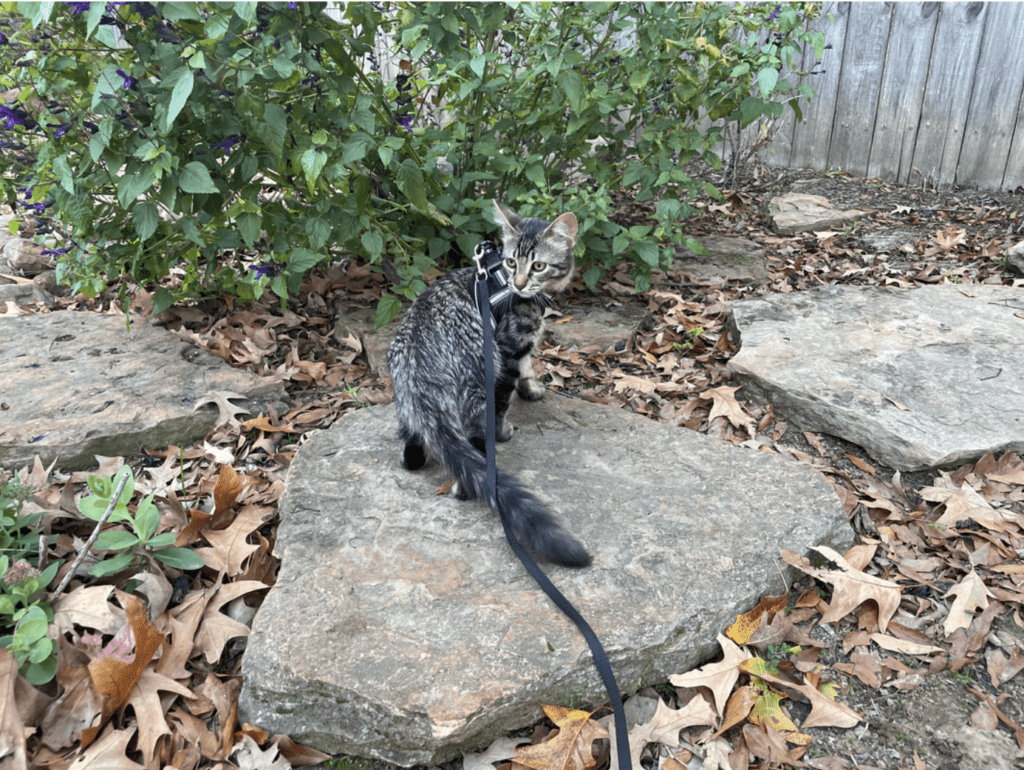
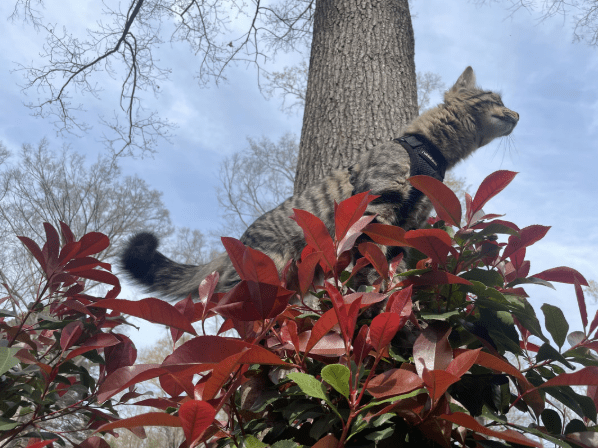
My rules for our walks are straightforward. The cat generally decides where we go, if he avoids roads and doesn’t roam far into a neighbor’s yard. He also can choose his activity, if he doesn’t climb more than ten feet up a tree, lead me into thorny bushes, or attack a bird or mammal. Stalking prey is acceptable, although my faulty supervision means that our yard is now The Home for Tailless Lizards. I allow Darwin to pursue crane flies, crickets, and cicadas, but I don’t like how he torments them once they’re in his paws and so I’ll often pull him away from them, too. His rules for our walks are simpler: he is the “decider,” and don’t you dare use that damned leash thing to pull meanywhere! Thus, our wills sometimes clash—but although cats don’t do compromise well, Darwin eventually submits to my vetoes.
This approximate balance of power means that cat and human remain reasonably happy on our saunters, which is what our walks mostly resemble: leisurely and aimless explorations. Sometimes, though, as I track his peregrinations, they feel more like a coddiwomple (lovely word, that): “travel in a purposeful manner toward some vague destination.” But that “vague destination” may have more to do with my limited understanding of Darwin’s intentions, rather than uncertainty on his part:
11:05 am: Out the door and onto the driveway: backyard or front? Darwin opts for the back. I obediently follow. Darwin’s bushy tail-flag waves as he trots along, and he looks like a genetic chimera out of Margret Atwood’s Oryx and Crake, with a standard mackerel tabby’s body married to a racoon tail (a “catoon”?).
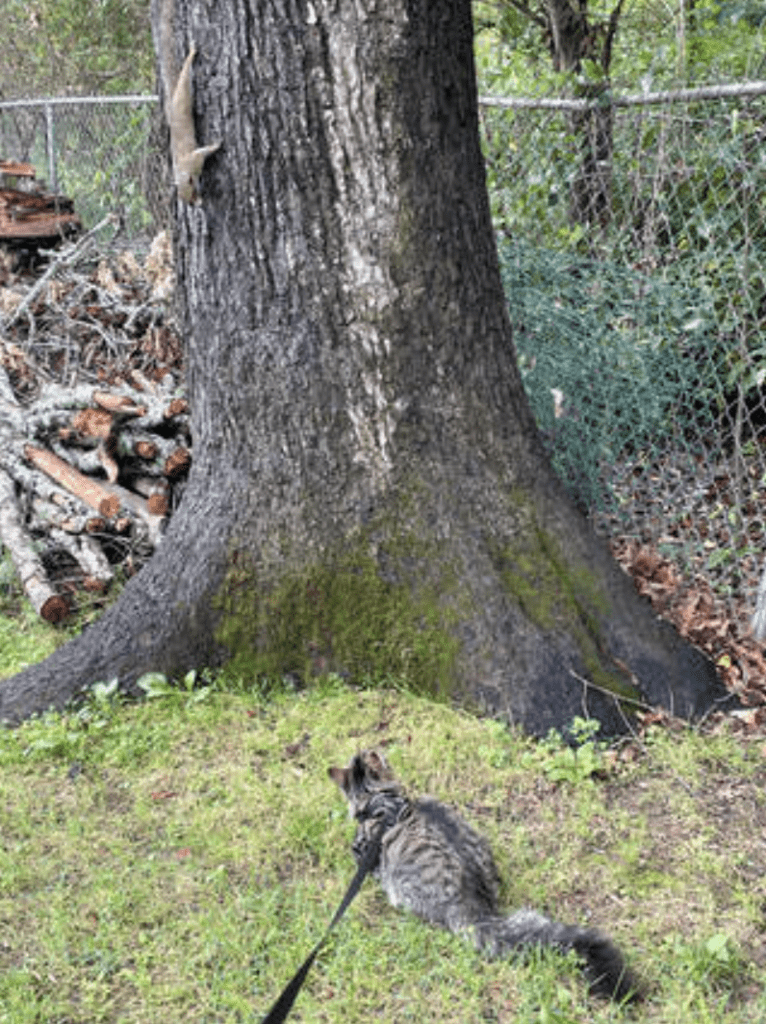
11:06 am: Darwin heads straight for the large water oak growing against the western fence, where a gray squirrel lies splayed against the trunk. It scolds us both, although the squirrel mostly seems focused on the cat. The squirrel quiets and for several minutes silently regards Darwin. The squirrel scoots up the tree and Darwin trots toward our backyard water feature, stopping to sniff the woodpile and stick his paw in several crevices—he always does this—before venturing on to the water.
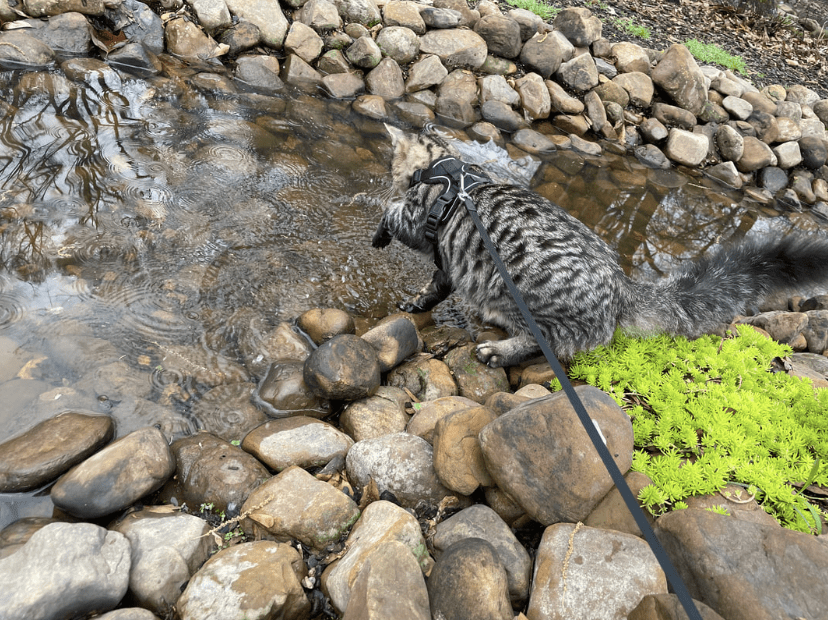
11:10 am: Darwin taps the water with his left front paw, shakes it off, dips again, repeating he sequence and venturing deeper with each dip. Soon he’s up to his chest. He drinks, looks up, then leaps across the water and turns east, his freak tail flag flying.
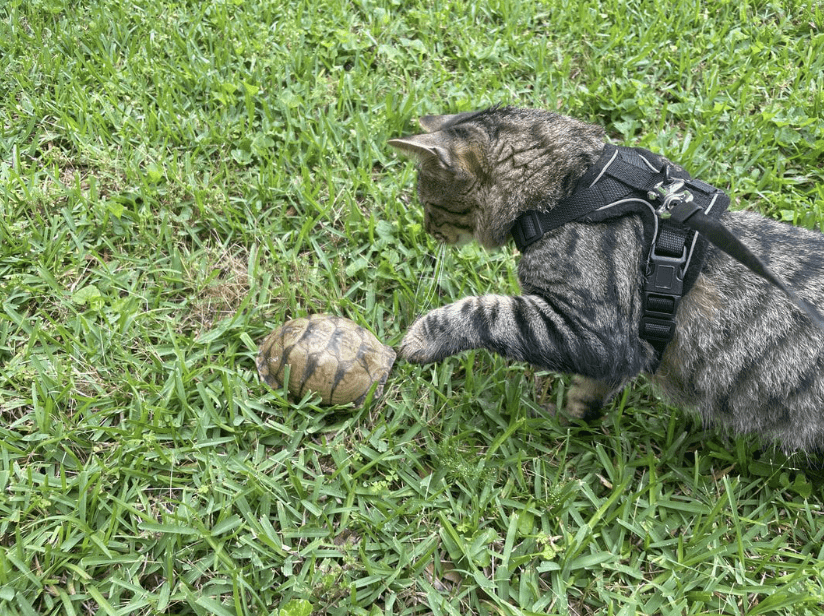
11:14 am: Darwin stops to investigate some grass, sniffs it, then eats a bit and moves on. I admonish him to drop his herbivorous habits, but he ignores me.
11:18 am: Darwin notices a robin foraging in our neighbor’s yard, slips into a crouch, and stalks up to the chain-link fence. He lies beneath a shrub, front paws extended, body tense with electricity, utterly focused. Quivering. His tail twitches repeatedly and he utters a rapid series of “eh-eh-eh”s. Simone Weil writes that “Absolute, unmixed attention is prayer,” and perhaps Darwin’s intense focus is a form of kitty prayer—but then the robin flies off and he relaxes. I let him climb the fence but pull him off when he reaches the top. He protests by twisting away from my grasp, but I set him back on the ground.
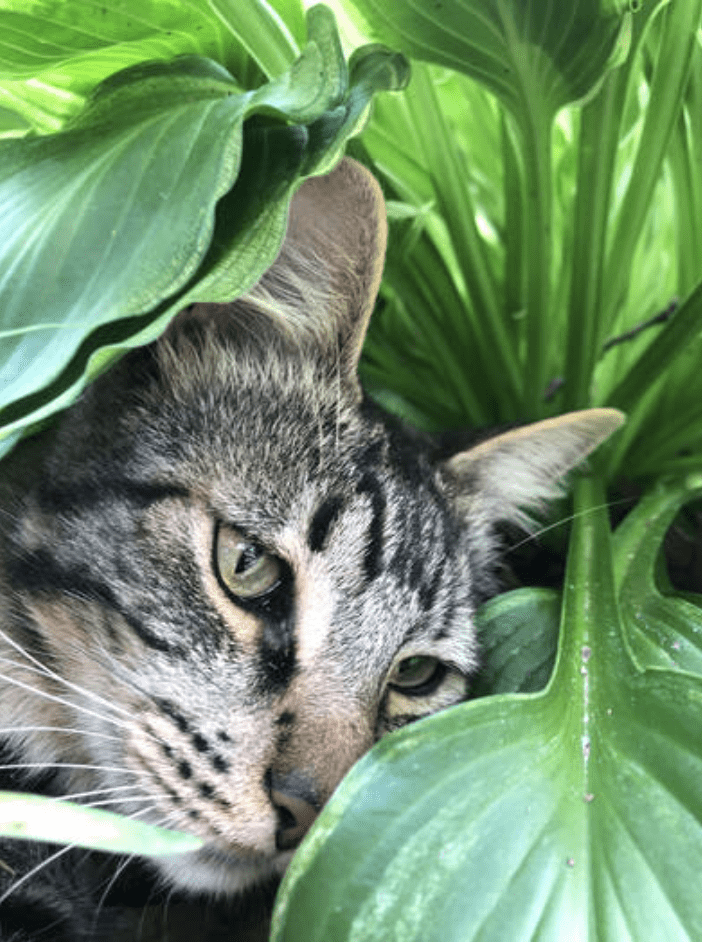
11:24 am: Darwin turns west, walks ten feet, then plops down in some hostas. For several minutes he’s still, eyes closed. Then he sniffs the hostas and attacks the ground with staccato-like movements of his front paws—back-and-forth, back-and-forth—before executing a 360-degree pivot, springing up, circling the patch, and frenetically repeating the paw-and-pivot process several times. At 11:31 he rises, trots north along the fence-line and heads for the front yard, his walk not yet half-done. . .
Walks with Darwin provide time for contemplation and one thing that I’ve been thinking about is a quotation from Henry Beston’s 1928 book, The Outermost House: A Year of Life on the Great Beach of Cape Cod: “For the animal shall not be measured by man. In a world older and more complete than ours, they move finished and complete, gifted with extensions of the senses we have lost or never attained, living by voices we shall never hear. They are not brethren, they are not underlings: they are other nations, caught with ourselves in the net of life and time, fellow prisoners of the splendour and travail of the earth.”
Although I love this passage, I disagree with Beston’s contention that “we are not brethren”—for Darwin’s (the man’s, not the cat’s) “descent with modification” means that we share a common ancestor with all organisms. In the case of cats (carnivores) and human (primates), their evolutionary lineages diverged about 87 million years ago. Okay, maybe the depth of this divide means that cats and humans aren’t technically brothers or sisters, but our two species are close relations, sharing placenta and fur, milk and sensory neurons, and remarkably similar genomes. Our worlds differ, but they turn in similar ways—a belief reinforced by walks with Darwin, which have helped me develop a richer and more nuanced view of his behavior than if he were “just” an indoor cat. I’ve participated in his interactions with the world and have come to know something about his experiences and the “whys” of his decisions. Perhaps.
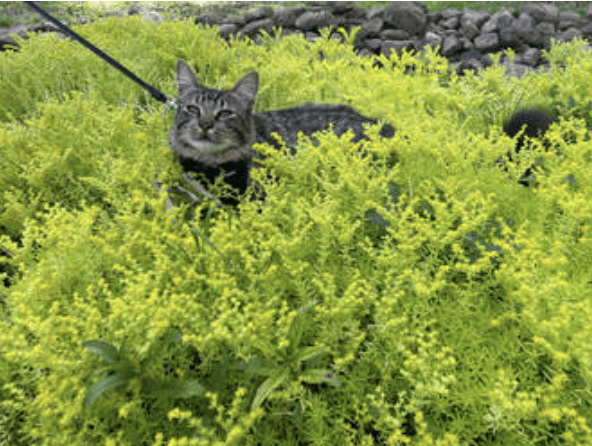
Although I might understand few details about Darwin’s sensory perception, our walks suggest that his experiences are rich, varied, and involve all his senses. He’s certainly visually oriented: a distant robin foraging on the lawn, or an anole poking out from the siding on our neighbor’s house, elicit a predator’s crouch and stealthy approach. And the shadow of a large bird passing overhead (a potential predator?) elicits a crouching response. But he’s an olfactory being, too, and sniffs just about everything he encounters—much more than when he’s inside. He’s also tactile (dipping his front paws in water, stirring the dirt in his favorite excavation), and auditory (loud sounds startle him, while the chatter of an alarmed gray squirrel draws his attention). And he’s a taste-oriented botanist, sampling many different plants during his daily rambles. Cat puke often follows.
There’s nothing much new in any of this for a dedicated cat owner, but there is for me. Until recently I’d never felt much connection to domestic animals. I paid them little mind, rarely watched and thought about them as intently as the wild creatures I’ve studied. Because I rarely brought domestic animals into my life their world always felt more alien than the world of wild ones. But Darwin has broadened my perspective and affections. Our walks allow me to watch, closely, as he moves through the world. Even given the large amounts of time that I’ve spent with wild animals, whether marked birds (Harris’s Sparrows at Warden’s Grove) or Inyo Mountains salamanders, profound obstacles have prevented me from understanding much about their experience—songbirds like Harris’s Sparrows are difficult to approach and follow, while the evolutionary distance between human and salamander greatly diminishes any possibility of direct “connection” (for want of a better word). But with Darwin, it’s been different. I can be close to him, I can watch, and I can learn.
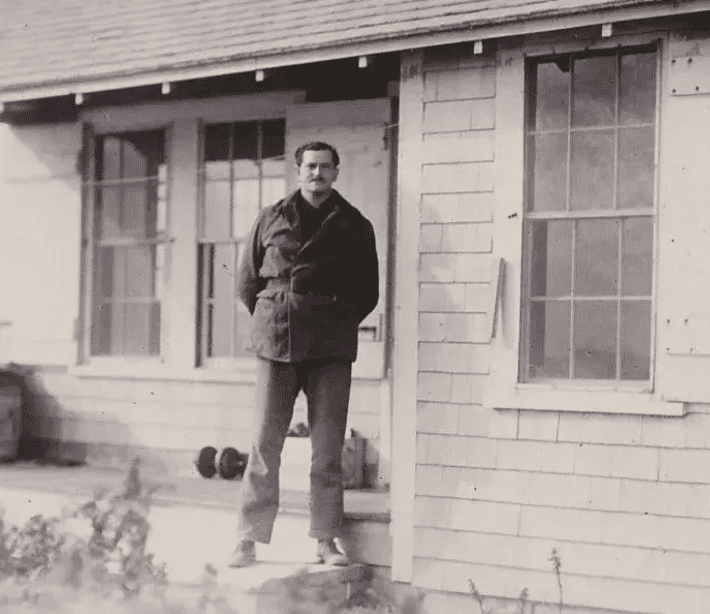
Still, philosophers and ethologists tell me that there’s a fundamental question here: what can I really know about Darwin’s experience of the world? We both are sentient beings and given our evolutionary history we share similar genomes and anatomy, but I don’t speak “cat,” don’t have a feline brain or experience the world through a cat’s eyes, ears, nose, tongue, paws. Does his subjective experience—what it’s like to be Darwin the Cat, out and about in Jackson—remain fundamentally unknowable to me? I can anthropomorphize, grant him feelings and emotions similar to mine, but that’s a long and dangerous leap, as the philosopher Thomas Nagel argued in his 1974 paper, “What Is It Like To Be a Bat?” Nagel concluded that it’s impossible for a human to know anything fundamental about the consciousness or subjective experience of bats (or any other non-human animal) and how they perceive the world. Instead, we only can understand what it’s like to be us (as an individual, less so as members of the same species). Think about bat echolocation and flight, or Darwin’s sensory and cognitive experience. We can describe them objectively, in terms of action potentials and neurotransmitters, but their effects—perception and subjective thoughts about the world—remain beyond our experience and so unknowable.
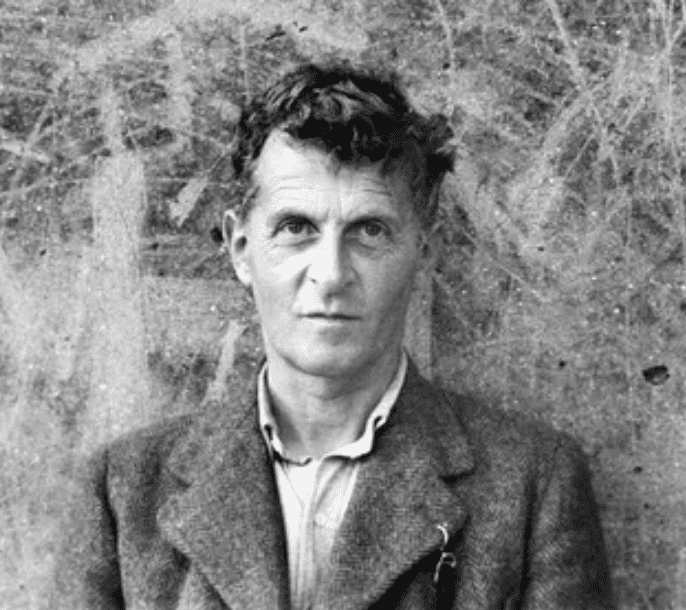
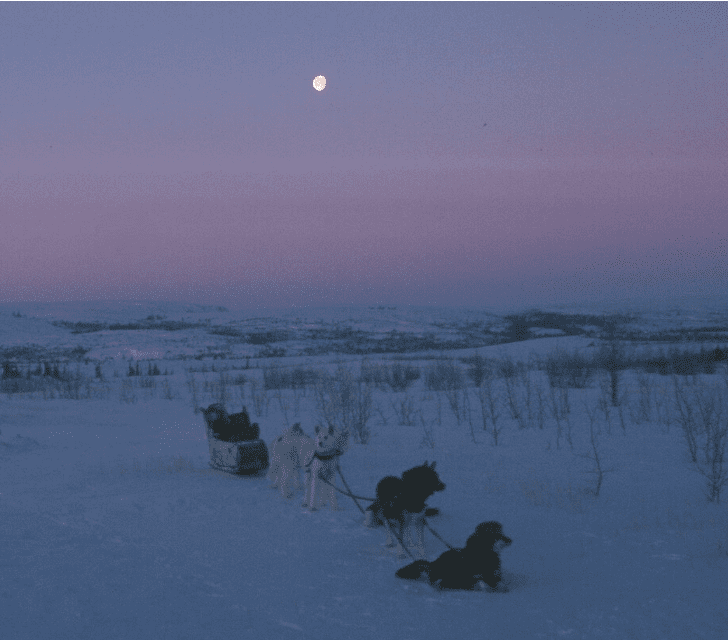
Nagel’s conclusion channels Henry Beston’s contention that we (human and non-human animals) are “other nations.” Maybe that’s partly true, but I believe that as “other nations” we still share common borders with other creatures. And the closer our evolutionary relationships and the more time we spend together—particularly outside, when more of the great world rushes in—the longer and more porous those shared borders become. The world is accessible to human and non-human animal as shared experience, even if our sensory and cognitive processes differ. It’s an understanding I first had when running sled dogs during my long-ago winter in the Northwest Territories: heading with a team into a bitter headwind at – 30°F and wallowing though bottomless snow, before cresting a ridge and seeing Home Hill beckoning, with its promise of shelter, food, and rest—and it’s a feeling I now have during my walks with Darwin. The novelist Michael Crummey described one of his characters as having “a cat’s self-centered indifference to the world as others saw it, a cat’s inscrutable motivations.” Maybe Crummey’s right about cats’ “self-centered indifference,” but I’d like to believe that Darwin’s motivations have become less inscrutable to me. And so, I’d modify what Wittgenstein (who most likely never owned a cat) said about felines: “If a lion could talk, we would not understand him.” I’d argue instead that, “When our young lion relative ‘talks,’ I understand a bit of what he’s saying.”
I track all of this—Beston, Nagel, Wittgenstein, one cat’s behavior and mystery—as I follow Darwin around the yard. Thoreau (who was fascinated by cats) observed that, “I have traveled a good deal in Concord,” and now, in Jackson, I have a willful and focused fellow creature to thank for a journey that’s taken me far from where I once lived, even though we’ve never left our home place.


Leave a Reply