EXPLORE THE BLOG
christopher Norment
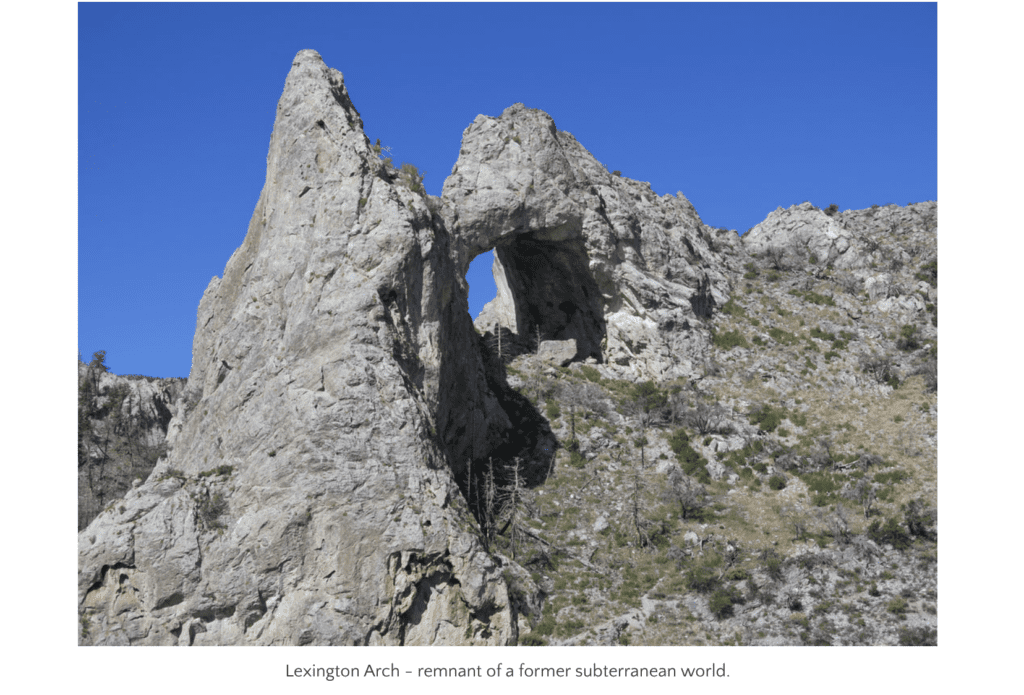
Yesterday an early storm brought snow to the high country. In a day or so, as September temperatures warm, meltwater will percolate through the thin soil, and where the rocks are right it will slip into limestone fissures, carrying a hint of acidity deep underground. As it has done for millions of years, the water will slowly make its way into deep time, dissolving the soft rock as it travels, forming a latticework of caves throughout the Snake Range. Some of these caves have eroded away, leaving only remnants of a former world, as with Lexington Arch, but in other places the cave systems remain. One of them, Lehman Caves, is large and filled with elaborate formations of precipitated calcium carbonate, and draws tourists from around the country. Others are small, less elaborate, and mostly unknown. But whatever their structure, many of these caves share a common feature that is more amazing than the most fantastical formations—endemic invertebrates, adapted to life underground, finding their way through an environment devoid of natural light, part of an ecosystem that subsists on the barest influx of energy from the outside world.
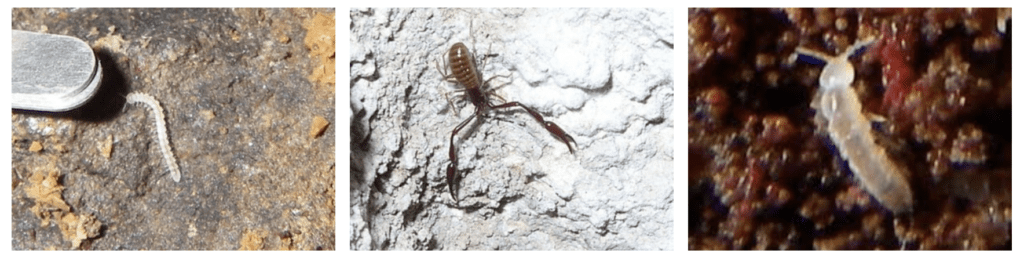
I was fortunate to see four of these endemic cave invertebrates with Gretchen Baker, a National Park Service biologist who guided me through Lehman Caves while they were empty of tourists. Along the way we (well, mostly Gretchen, who has developed an amazing search image for creatures that are in some cases no bigger than a fleck of dandruff) found the Snake Range millipede, Great Basin cave pseudoscorpion, and two types of springtails, close relatives of insects. The largest of these was the pseudoscorpion, perhaps ½ inch long, the apex predator in the system. The millipede, which feeds on detritus, was a slip of a thing, maybe 5 millimeters long, not much wider than a cat’s whisker. And the springtails—they seemed like little more than a whisper of life, just a millimeter or two long, almost impossible to see without a hand lens.
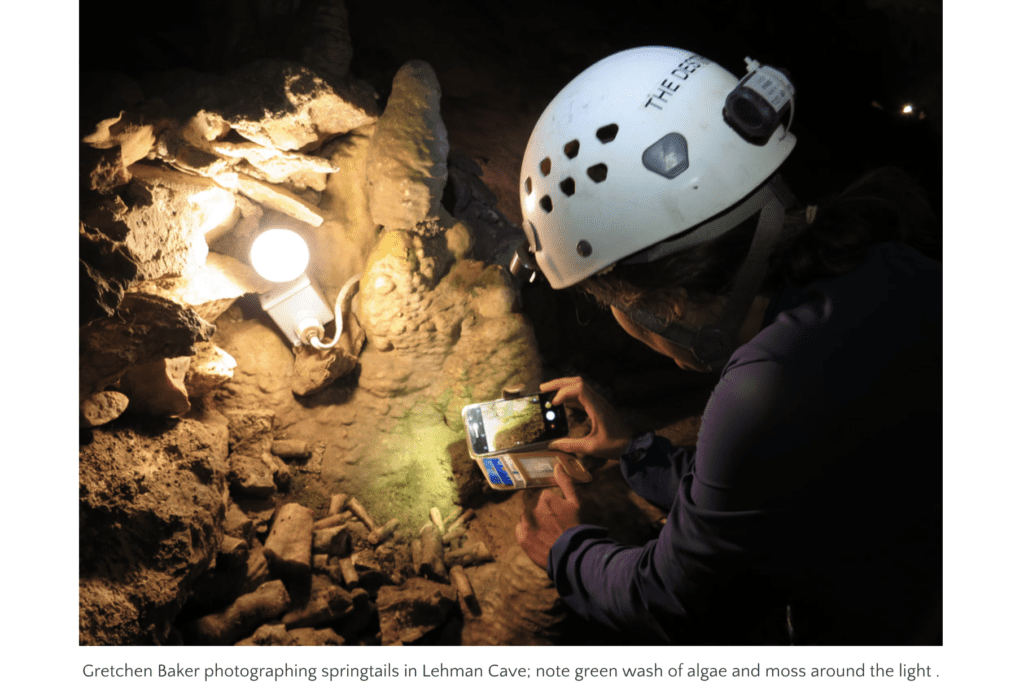
There was much to think about in the quiet dark, as we flipped rocks and probed out-of-the-way alcoves—nutrient cycling and energy flow, adaptations to a subterranean environment, fossilized packrat middens that preserve a Pleistocene world. And then there were the effects of humans on the cave: entire ecosystems based on moss and algae growing around small light fixtures, springtails gathering their sustenance from lint left behind by visitors. But mostly I was taken by the stories of those tiny creatures: how they came to inhabit the caves, how they have persevered and flourished in such an alien environment, what they might teach us about the world. Thousands and thousands of generations, adapting to the great environmental changes that have wracked the Great Basin, living out their lives in such a place, unique to this world, minute miracles of exoskeleton and muscle, going on.
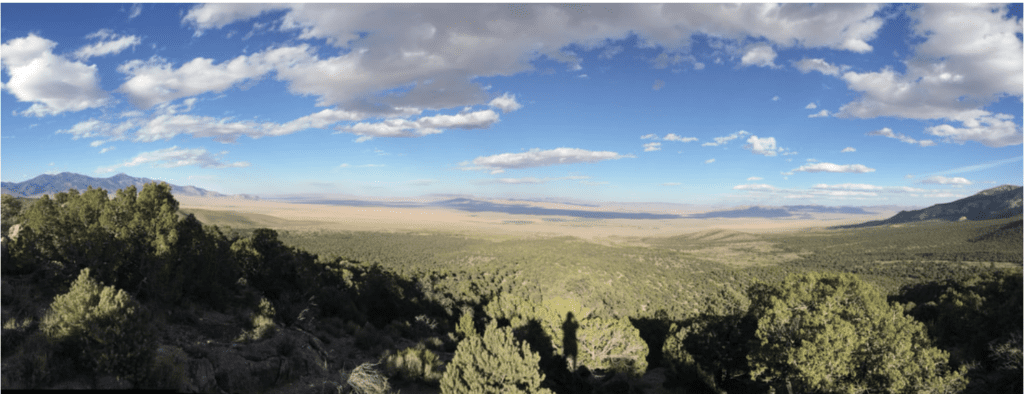
Later that day I grabbed my journal, a sit-pad, and an IPA, and walked up a nearby hill to watch evening slip over the Great Basin. The hill commanded a spectacular view of the Snake Valley and its surrounding ranges—and although it stood only one-half mile from the compound where many park employees live, there was little evidence of recent visitors. It was quiet and peaceful, with just the slightest breath of a downslope breeze sifting through the pinyons and junipers. A scatter of cloud-shadows drifted across the desert, turning toward red-brown and gold as evening came on. Around the settlements of Baker and Garrison, clusters of electric-green center-pivot fields lay like symmetrical islands in a sea of saltbush and greasewood. Rough Cambrian limestone beneath my pad, the distant complaints of a Steller’s Jay, a faint scent of sage: a nice place for an IPA, an even better place for contemplation.
It was difficult to wrap my mind and heart around the space that lay before me: to the north, the great bulk of Mt. Moriah and long run of Snake Valley; to the east, forty-five miles away, Notch Peak; to the northeast, perhaps sixty-five miles distant, the tip of what I took to be the Fish Springs Range, a shadow rinsing behind the Conger Range. I wanted the view—or my visceral response to it—to lodge permanently within me, but desire is stronger than memory and I knew that the presence of the place would become less substantial with the passage of my days.
Still, the vastness of the Basin and Range country pulled me into what the Australian writer David Malouf described as “an opening distance” in myself. But my imagination was drawn, just as powerfully, to the tiny cave arthropods that I had seen earlier. The juxtaposition of scale and effect—from what felt like the infinite (this view!) to the minute (the seemingly most insignificant of animals)—left me giddy and slightly disoriented. But I understood that the invertebrates of Lehman Caves were every bit as beautiful as the great and widening space before me.
As night came on I gathered up my things and descended from the hill. And as I wandered through the pinyons and junipers, I thought of pseudoscorpions and millipedes and springtails, and the first stanza of William Blake’s “Auguries of Innocence”:
To see a World in a Grain of Sand
And a Heaven in a Wild Flower,
Hold Infinity in the palm of your hand
And Eternity in an hour.


Leave a Reply