EXPLORE THE BLOG
christopher Norment
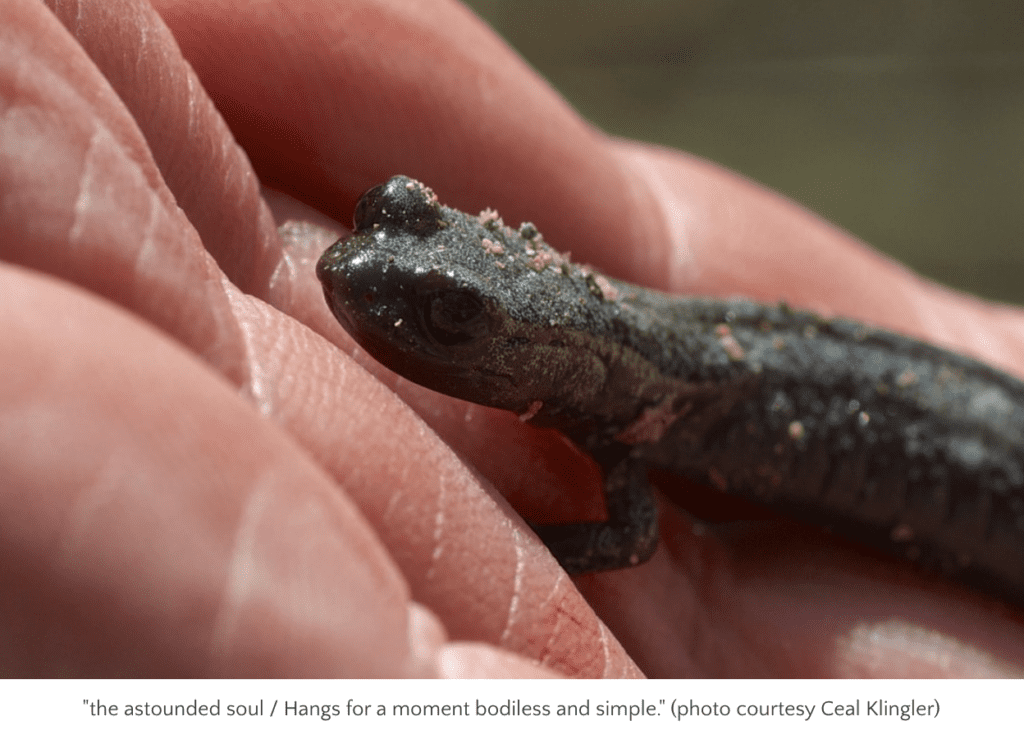
“the astounded soul / Hangs for a moment bodiless and simple / As false dawn.”
Richard Wilbur, “Love Calls Us to the Things of This World”
Love may call us to the things of this world, but why are we called to love by such disparate things? Why does one person discover their emotional valence—“the capacity of something to unite, react, or interact with something else”—in the noise-drenched crowd at a NASCAR race, while someone else is summoned, just as profoundly, to the lush green silence of an alpine meadow? Perhaps the lure of particular things (people, places, objects, etc.) is a simply matter of nature and nurture, but I doubt it. Beyond the powerful push of genes and environment—the transformation of DNA and experience into flesh and blood and behavior—there is the profound mystery of recognition, of coming into a place that feels like home. Lock and key, enzyme and substrate: the fit is not always easy to explain. Think of the things that you love: Why?
Consider, for example, desert salamanders.
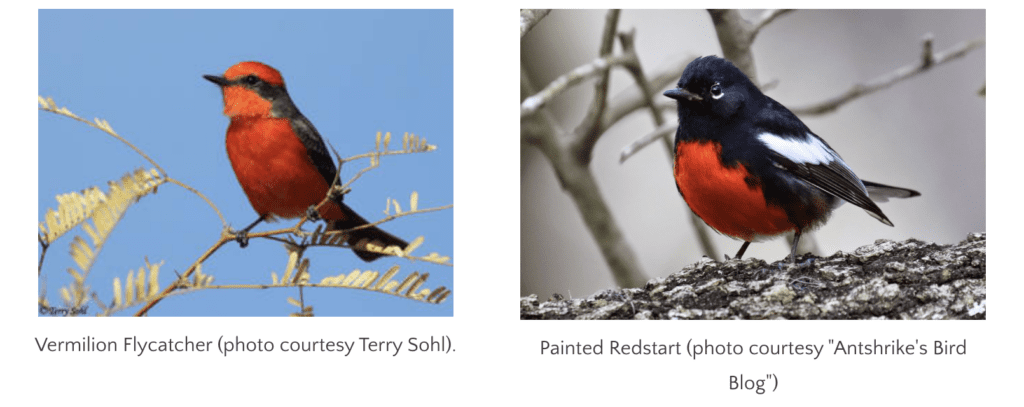
I have studied birds for most of my professional life. My first experience with field biology came when I worked as a summer field assistant on a study of how highways impact riparian birds. Over the course of three field seasons I grew to love ornithological research and Southwestern birds, from Vermilion Flycatchers to Summer Tanagers and Painted Redstarts, and the rest followed (if not always easily, at least predictably): master’s and PhD studies on avian ecology, and a research program at Brockport mostly involving birds.
So, why switch from birds to Inyo Mountains salamanders? My fascination with salamanders is curious and complicated. I am drawn to them for many reasons—some obvious, others more mysterious and ineffable. One explanation has to do with place. The salamanders live in a spectacular desert mountain range just to the west of Death Valley—country that I came into, and came to love, in the mid-1970s, when I followed feral burros through the spare and spacious beauty of the Panamint Mountains. My fieldwork for Relicts of a Beautiful Sea, circa 2009 – 2013, was an excuse to return to the Death Valley region, and the ideas, questions, and emotions generated by writing Relicts pointed me toward the Inyo Mountains salamander. But I sought out the salamander, among all of the other interesting organisms (many of them birds) that I could have chosen. This was a conscious act, yet one with a murky set of underlying causes, as with so many of our decisions, from the important (marriage, career, children) to the mundane (vacation destination, movie preferences, clothing).
Another reason for my project is that teaching Herpetology (a course on reptiles and amphibians) at Brockport forced me to pay attention to salamanders. Herpetology begins in the depth of winter and ends in early May. Fieldwork is impossible until the end of March, and then the main actors are amphibians, among them eleven species of salamanders. Seven of these are in the family Plethodontidae, or lungless salamanders, which also contains the Inyo Mountains salamander. And so my initial field encounters with New York’s salamanders led to fascination, and fascination led to a series of student research projects—and in the process I began thinking about salamanders in a serious way.
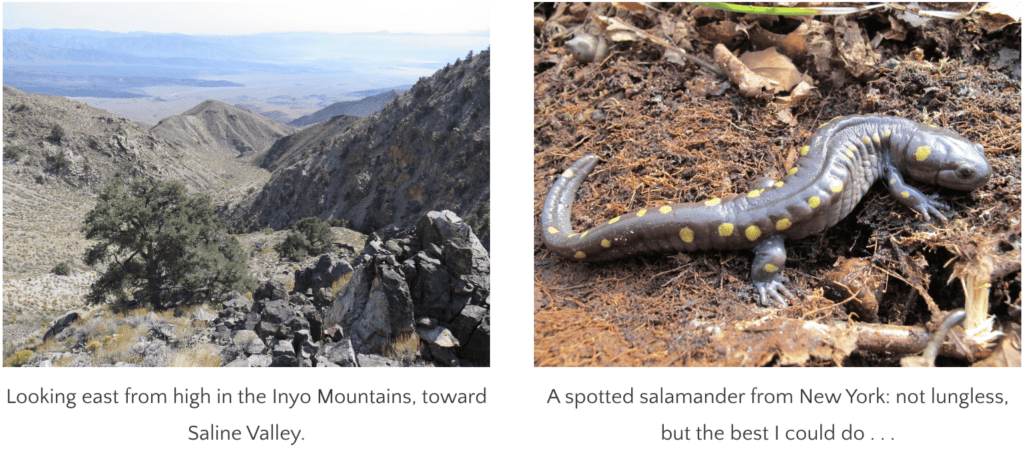
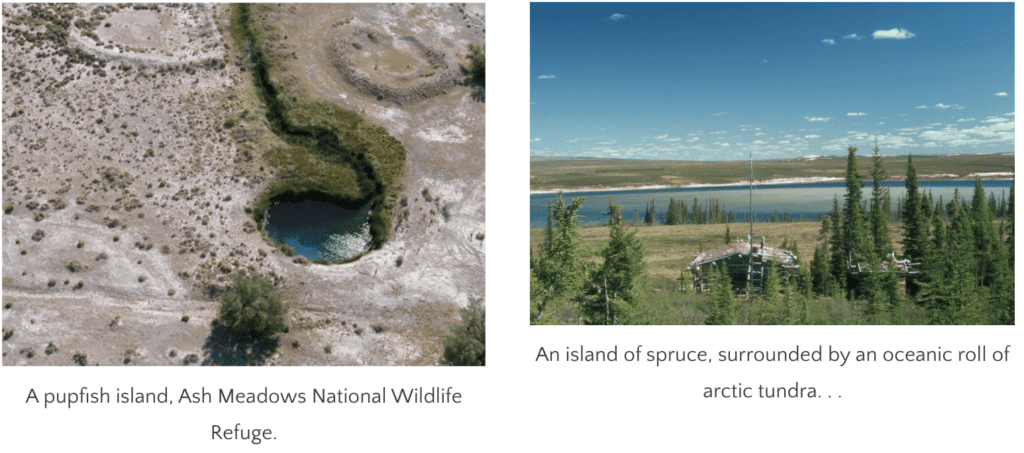
And then there is the Inyo Mountains salamander’s “islandness”: its only home a fault-block desert mountain range, with a distribution restricted to twenty-two small patches of riparian habitat, each surrounded by a harsh and unforgiving world, and so islands within a larger, montane island. Islands: to use a term coined by E. O. Wilson, I am at heart a “nesiophile,” someone with “an inordinate fondness and hungering for islands.” The islands that excite my imagination include true oceanic islands, like Lord Howe Island and Rarotonga in the South Pacific, as well as habitat islands like the Great Basin mountain ranges—or on a smaller scale the springs and seeps that shelter so many of their creatures.
I became conscious of my nesiophilia in 1980, during my first year of graduate school at Washington State University, when I read the Theory of Island Biogeography, by Robert MacArthur and E. O. Wilson. The ways in which their scientific ideas dovetailed with my imagination soon had me seeing islands everywhere in eastern Washington’s Palouse country, from hedgerows and shelterbelts to isolated stands of ponderosa pine and remnant prairie patches. And then there were memories: of seeking refuge from the summer’s heat among the pine and fir forests of some Arizona “sky island,” after a long day of fieldwork; or of the eleven months that I had spent at Warden’s Grove, a small cabin sheltered by a tiny island of white and black spruce at the farthest edge of the boreal forest, surrounded by an oceanic roll of arctic tundra. . .
The islands of my imagination became the islands of my research: bird communities of subalpine forest patches in the Beartooth Mountains; Harris’s Sparrows nesting in wind-flagged spruce stands along the Thelon River in the Northwest Territories; breeding birds in New York’s increasingly rare, island-like grasslands; a species of tiger beetle, restricted to isolated cobble bars along the Genesee River; and pupfishes in slips and springs of desert water.
But years before I’d even taken a herpetology course, stalked burros in Death Valley, or recognized my fascination with islands—before I’d even spent much time as a field biologist—an inchoate fascination drew me to western lungless salamanders from isolated mountain ranges. And I recall when I first recognized my attraction: the summer of 1971, when I worked on a fire ecology project on the North Rim of the Grand Canyon. One day, while thumbing through Robert Stebbins’s Field Guide to the Amphibians and Reptiles of Western North America, I stumbled across brief descriptions of the Jemez Mountain and Sacramento Mountains salamanders (the Inyo Mountains salamander would not be described for another eight years). These species are isolated endemics restricted to mountain ranges in New Mexico, and I was taken by their presence in what seemed like such incongruous places. Although I never sought them out, the stories of those two species were part of my imagination for thirty-eight years, before I began exploring, deeply, the life of another salamander endemic to western mountains.
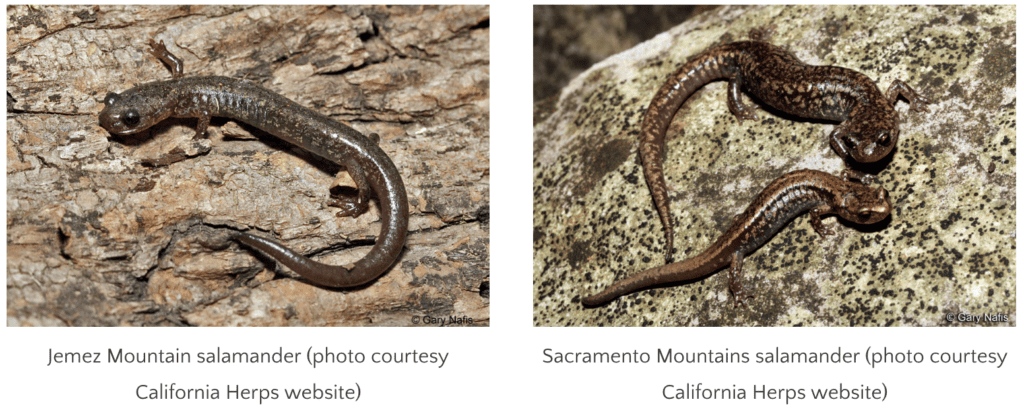
The Death Valley region, teaching herpetology and developing a passion for salamanders, islands and nesiolphilia, and western mountain endemics: all are ingredients of my obsession with Batrachoseps campi. Yet the sum of these explanations feels insufficient, perhaps because some vital component is missing. It’s as if I have imagined a multivariate equation that includes four or five precisely measured but relatively unimportant variables, and one critical but unknowable one, which renders the equation useless. My search for a clear explanation seems like an alchemist’s fantasy: lead into gold, cold fusion, trickle-down economics.
Ultimately, I sense that my questions about attraction and passion will go unanswered, at least in any clear way. I never will fully understand why, in the presence of an Inyo Mountains salamander, I encounter such joy and excitement. But perhaps I am being too analytical. Perhaps it is more than enough to feel—to have been granted that type of connection that we all wish for, and which gives our life its greatest pleasures: that journey out of the self and into a place where, as the poet writes, “the astounded soul / Hangs for a moment bodiless and simple.”